The Science Behind Frankenstein; Frogs, Batteries, and a Dead Man
Dear Reader,
Do you like the feeling of being scared? The rush of adrenaline in the moment can provide a thrill that many chase. However, I don’t like the fear that lingers, the type that keeps me up in the middle of the night. As a child, I was easily afraid by movies such as “I,” where (spoiler alert) a man is injected with a serum to physically deform him so he cannot marry the female lead. I was intrigued by his story, but the power the evil scientist had to mutilate him frightened me for months afterwards.

My parents would reassure me that the man’s condition was not real, that it was just makeup, and that nothing like that was ever going to happen to me. However, my older brother, as older brothers do, could not stand my parents’ simplified worldview even if it was only meant to comfort me. So, he informed me that my parents were lying, that people live with similar conditions, and that I was going to have to deal with it if I was ever going to be a doctor. The honesty is appreciated now, but the ongoing nightmares, sleepless nights spent staring at my ceiling, and general anxiety I felt were not.

All of this is to say that the fear of monsters consumed a sizable portion of my childhood. I found a kindred spirit in Junior from Veggie Tales. In “You Don’t Need to Be Afraid of Monsters,” he lies awake in his bed, afraid of “Franken-celery” from the movie he had just watched. Similar to my parents, Larry and Bob point out that it was just a movie and the creature was actually just an actor in makeup. You obviously can’t resurrect people with electricity, that’s crazy!

Unfortunately for Junior, that isn’t entirely true. While Frankenstein is a work of fiction, it is based on real science (which also marks this book as the beginning of the science fiction genre). Real experiments with electricity on animal and human corpses inspired Shelly’s shocking story. Some of these experiments are foundational to our everyday lives, while others are just as unusual as Dr. Frankenstein’s unfortunate tale.
Frogs

Luigi Galvani was a physicist and physician who was initially interested in the anatomy and physiology of the ear. This all changed when his assistant–his wife Lucia or his nephew Aldini, it isn’t clear who– touched the femoral nerve of a dissected frog leg with a scalpel. There was a small spark from a nearby electric generator as the muscles in the disembodied leg began to convulse. From that point in the early 1780s onwards, Galvani focused his research on understanding this phenomenon that he termed “Animal Electricity”.

The relationship between electricity and muscle movements had been observed for decades. Still, Galvani’s research was significant as it provided a reasoning (though somewhat flawed) behind how this was possible (Cambinghi). He proposed that animal electricity was a fluid secreted by the brain, then conducted by the nerves to the muscles to cause movement.
Galvani supported his theory through continued experimentation with frogs and eventually published his work in De viribus electricitatis in motu musculari commentarius (Commentary on the Effect of Electricity on Muscular Motion). These findings were groundbreaking; many believed that Galvani had revealed the life force that physiologists had been looking for (Williams). Emil Du Bois Reymond, a German physiologist, describes that it was “believed that any treatment would be possible, and that any apparent dead body would not have been buried before being galvanized.”
Galvani gave an inscribed copy of De viribus electricitatis to his colleague Alessandro Volta, a young Italian scientist who specialized in electricity and magnetism. Volta was initially thrilled by Galvani’s discovery and described it as “one of those great and brilliant discoveries which deserves to mark a new era in the annals of physics and medicine.” However, Volta began to question Galvani’s findings. He theorized that it was the metals used that were producing the electricity instead of the animal itself, a theory he eventually termed chemical electricity. In Volta’s perspective, the frog was merely an “electroscope,” something to detect energy but not itself make it.
The difference between animal electricity and chemical electricity may seem convoluted, but it is an essential question of how living things function. For a simple analogy of Volta’s perspective, consider how a lightbulb works. The bulb itself does not generate any energy; lightbulbs merely convert electrical energy to light energy when attached to a power source or screwed into an outlet. Similarly, Volta argues that the disembodied frog leg itself does not produce any energy, but will convert electrical energy into muscle movements.
Galvani, however, argues that the frog legs act as both a source and a converter of electrical energy. The theory of animal electricity can be compared to a crank flashlight or a flashlight that makes and stores its own electrical energy. The intrinsic ability to generate and release electricity was precisely what made animal electricity appear as the fabled life source science had been searching for.
With our modern understanding of electricity, you may already see the large holes in Gavlani’s theory that Volta had picked up on. Whether or not animals generate their own electrical life force, Galvani's application of electricity to frogs’ legs doesn’t prove that the legs are generating a life force, only that they react to electricity. Thinking back to the flashlight and bulb analogy, if you were to jolt a normal lightbulb and a crank flashlight with electricity, they would both light up because they react to electricity regardless of its source. However, just because the light bulb reacts to electricity does not mean it generates its own electricity like the crank flashlight. To put it simply, Galvani’s conclusion was one step ahead of his data.
Galvani was correct that animals can generate their own electricity, but where he faltered was in his understanding of how electricity worked. Electricity was not well understood at the time of Galvani’s discovery, so equating electrical stimulation to intrinsic electricity generation was a plausible reason for this phenomenon—until Volta proved it wrong.
Batteries

Volta began testing his hypothesis by researching how to generate electricity from metals. Reportedly, he would test the conductivity of metals by placing them on his tongue to feel the weak flow of electricity, essentially using himself as the electroscope. With one metal on top of the tongue and a dissimilar metal below, a strong electric current produced a strong sour taste. His research resulted in the Voltaic pile, a stack of alternating, dissimilar metals soaked in salt water that could “produce” electricity. In other words, Volta demonstrated the existence of chemical electricity by making the first true battery (which is also where we get the term “Volt” from), leading to an electric evolution.

This voltaic pile cemented Volta’s theory of chemical electricity over animal electricity. Galvani attempted to refute Volta’s claims by anonymously publishing experiments that demonstrated how nerve-to-nerve contact could create the same effect as chemical electrical stimulation. This experiment would have corrected for Galvani’s initial oversight, as the animal is acting as the source of electricity. However, the damage was already done. Volta’s argument had a more solid scientific backing, and Galvani soon died after the creation of the voltaic pile and at the cusp of the electric revolution. Volta’s chemical electricity quickly took off and was used for mechanical innovations, leading to a strong association between electricity and machines rather than electricity with life.
A Dead Man
Remember Galvani’s nephew and assistant, Aldini? Not only did he play a role in the discovery of animal electricity, but he also went to great lengths to prove his uncle’s theory. In fact, he went as far as blurring the line between life and death.

Once Galvani passed, Aldini acted as his scientific successor and aimed to defend his uncle’s work. He moved from manipulating frog legs with electricity to other animal carcases, such as dogs and cows. To establish living things as the source of electricity, Aldini used himself to conduct electricity through an animal. He and his assistants would wet their hands with salt water, and he would then position his hands in place of wires.

You can see here how Aldini’s work improved off of his uncle’s oversights. Galvani’s experiments displayed how muscles react to electricity by using metals or lightning to conduct electricity through animal tissue and produce a contraction. Aldini, on the other hand, uses living things (himself and his assistant) to conduct electricity through animal tissue to produce the same effect. Now, this isn’t to say that Aldini and his assistant are some how controlling the circuit or acting as batteries. Rather, this experiment demonstrates the ability of living things to conduct electricity The human body’s high water content is saturated with various ions, making it a good conductor of electricity—replace the people with glasses of salt water and you’d get the same result. Still, these findings are undeniably fascinating as it appears to demonstrate a common life force that invigorates the living can be used to spark something similar to life in the dead.
Aldini’s work eventually moved to human subjects in an attempt to cure diseases, such as applying electricity to the head of a depressed farmer to cure him of chronic depression (a primitive form of electroconvulsive therapy). Rather than human circuits and salt water to deliver current, Aldini ironically relied on the more convenient voltaic pile. The invention that had initially disprove animal electricity was now being used to advance it.

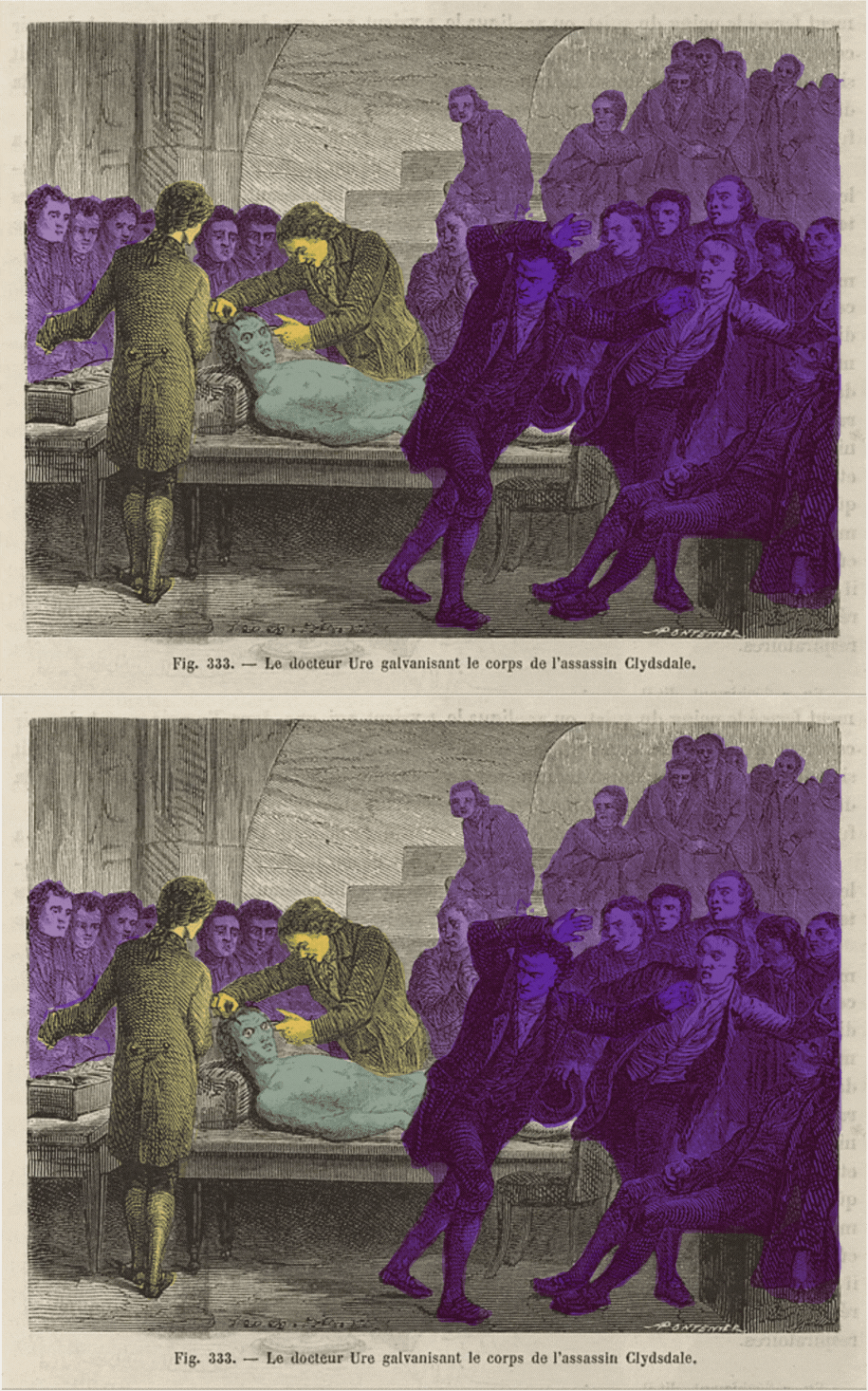
Among all of these interesting experiments, Aldini’s crowning achievement was his experimentation with the corpse of George Forster. After Forster was executed for the murder of his wife and child, Aldini was allowed to experiment on the body at the Royal College of Surgeons. In front of a crowd of doctors and the general public, Aldini used a voltaic pile and a various placement of wires to contort Foster’s face, open one of his eyes, punch his right fist in the air, and '“set his legs in motion”. These movements mimicked the appearance of life and shocked the audience; it was even reported that a man was so alarmed that he died soon after he returned home from the display. It was this ghastly resemblance to life that inspired scientific conversation about the nature of life and incited Shelly’s own waking nightmare.

Conclusion
The power science has given humanity is often criticized and feared. Shelly’s novel could be read as a critique of Aldini’s experiments and a warning against pursuing such research (and not just because publicly electrocuting corpses is highly unethical). It is this fear of the power science had that gripped me as a child, just as it gripped those who were there to watch Aldini’s experiment.
Today, however, these experiments do not elicit fear but feed my imagination. Electricity is intimately tied to life itself, and by recognizing this tie, medicine has been able to do what was once impossible. Shock paddles, for instance, literally jolt people back to life by electrically stimulating the heart, fulfilling Emil Reymond’s prediction that bodies would not be buried “without being galvanized.”
Despite the breakthroughs bioelectricity has provided, there is still much to do to expand this field. Even today, we face the issues that Galvani faced with animal electricity nearly 300 years ago–it is much more difficult to research electricity with the complexities of living organisms than it is with chemical electricity in machines. We only know a fraction of the potential that electricity has to heal ailments, but now is the time to push the boundaries of this knowledge. With our current technological advancements in medicine and machine learning, we may be on the precipice of (or already in) a bioelectric revolution.
What will this revolution look like? What diseases could be cured by viewing them from an electric perspective? What parts of our biological circuitry can be used to advance technology? Could reanimating the dead ever be achieved? Should it be achieved? Rather than a fear of monsters, it is now these questions that I lie awake thinking about. Whether out of fear or fascination, I suppose visions of mad scientists and monsters won’t leave me to rest in peace anytime soon.

P.S. Citations in case you wanted to do some digging of your own!
Aldini, John. “An Account of the Late Improvements in Galvanism (1803).” The Public Domain Review, 2011, publicdomainreview.org/collection/an-account-of-the-late-improvements-in-galvanism-1803/.
Cambiaghi, Marco, and André Pare. “From Aldini’s galvanization of human bodies to the Modern Prometheus.” Medicina Historica , vol. 2, 2018.
“GEORGE FOSTER: Executed at Newgate, 18th of January, 1803, for the Murder of His Wife and Child, by Drowning Them in the Paddington Canal; with a Curious Account of Galvanic Experiments on His Body.” The Newgate Calendar - George Foster, www.exclassics.com/newgate/ng464.htm. Accessed 22 Feb. 2026.
Ilott, Ruth. “’it’s alive!’ - notes on Giovanni Aldini’s experiments with galvanic fluid.” The Bulletin of the Royal College of Surgeons of England, vol. 104, no. 7, Oct. 2022, pp. 363–363, https://doi.org/10.1308/rcsbull.2022.136.
Williams, B. Innes. The Matter of Motion and Galvani’s Frogs. Rana, 2000.
Comments
Post a Comment